Climate urgency pressures have necessitated innovative city planning. More than coping with the UN projected 68% of the world population living in urban areas by 2050*, cities currently account for over 70% of global emissions*. The continual increase in emissions has seen countries globally experiencing abnormality in seasons and weather climate. In the South Asia region, an unusual series of storms and major cyclones has happened and claimed as many as 1,600 lives since mid-November 2025, across Indonesia, Vietnam, the Philippines, Malaysia, Thailand and Sri Lanka. The torrential rain and conditions have also triggered land slides, aside from floods; devastating places and home, forcing people to flee*. Quoted from an article by Inside Climate News, release on December 9, 2025:
“Though the storms were partially fueled by natural weather cycles, scientists say that climate change helped supercharge rainfall, arising trend across South and Southeast Asia, which is warming nearly twice as fast as the global average. At the same time, deforestation and rapid urbanisation in the region may have exacerbated flood impacts by uprooting nature’s flood barriers.”
Escalated human activity in urbanisation is one of the key contributors to the Urban Heat Island (UHI) phenomenon*. Cities, as concrete jungles, are localised hotspots. Other than the choice of construction materials, buildings are typically densely packed to maximise buildable areas, with Blue-Green Infrastructures (BGI) often treated as an afterthought. UHI under these circumstances can intensify heatwaves and radiation*. Thus, causing over-reliance on active cooling systems such as air conditioning. This, in turn, releases more greenhouse gasses that fuel climate change.
We at WY-TO believe that Urban Ecology as a planning methodology can assist in closing ecological gaps caused by cities’ expansion. Rather than developing conventional, sterile built environments, metropolises are instead treated as living, breathing ecosystems. Practitioners thus focus on designing for management and conservation of natural systems – otherwise known as Ecosystem-based Approaches (EbA). Urban longevity is thus reevaluated and benchmarked by resilient, restorative and regenerative virtues. For instance, an urban planning model conceptualised by the late Yu Kongjian – Sponge Cities*. This model reshaped China’s urban development plans and has since become part of her national urban development initiative*. Urban Ecology is identified by three individual and layered, nested spheres as per the Global Development Research Centre (GDRC), the Japan based independent policy think tank. First, the Natural Environment, followed by the Built Environment, and lastly, the Socio-economic Environment.
WY-TO.jpg)
The holistic concept positions urbanised areas as living systems in which different actors and stakeholders converge, convene, and intertwine to create hybrid relationships*. As such, Urban Ecology requires non-linear, dynamic management in balancing and integrating interdependencies*. In Singapore, from the initial ‘Garden City’, the Nation’s top-down vision has progressively transformed to the current 'City in Nature'. Generous green spaces existing as skyrise greenery, dedicated land for urban parks and integrated blue networks, and tree-lined boulevards, are part of efforts to bring back lost fauna through the presence of flora. Eg. Nature-integrative buildings may become habitats for pollinators such as butterflies and bees, or attract species of birds. To date, NParks notes in the 2023/2024 Annual Report that the densely populated island nation is more than 40% covered in green*. The increased natural capital, too, has contributed to ongoing plans for more efficient and sustainable urban drainage systems (SuDS) and stormwater management.
WY-TO.jpg)
Viewing cities as ecosystems can encourage more encompassing design processes – a perspective deeply embedded in our research on well-being. Strategies found inside our Well-being for All research illustrate how one action can address components found in the web of ecosystem relationships. Beyond addressing water security and flood concerns, Blue-Green Infrastructure (BGI) spaces, recorded in our research, can be actively optimised. Once functional built networks can purposefully serve more stakeholders and bolster ecological relations. Lower Pierce Reservoir in Singapore exemplifies this. The freshwater body is designed and included as part of a recreational nature trail. Surrounding forested areas, with the presence of the blue catchment area, can further extend biodiversity links and improve ecological connectivity in proximity.
WY-TO.jpg)
Another relevant example is our tender proposal for a new resilient coastal town, located in the North of Singapore, in which, ecosystem-based approaches (EbA) were prioritised. Our masterplan adopts the decentralised 'Live-Work-Play' and 'Slow-mobility pioritised' to transform and rejuvenate the existing military area. Together with our collaborators, we carved out abundant green spaces and interlaced them with blue infrastructures to strengthen rewilding endeavours. Design is rethought to initiate co-ownership with Nature. More than to repair and connect broken biodiversity and marine life links, they form the basis for a resilient coastal protection network from the surrounding waters and bolster against rising global sea levels. Accordingly, our approaches informed different coastal and inland typologies, a robust sponge system, amongst others, and serve as social recreational hubs to connect the wider community nodes. Slow mobility opportunities are then shaped through active corridors in support of Singapore’s various agendas relating to Health and Wellness that target people, eg. The Green Plan 2030 that addresses Climate and Planetary Well-being. Thereby, enabling town longevity and bolstering adaptability to climatic changes and weather events.
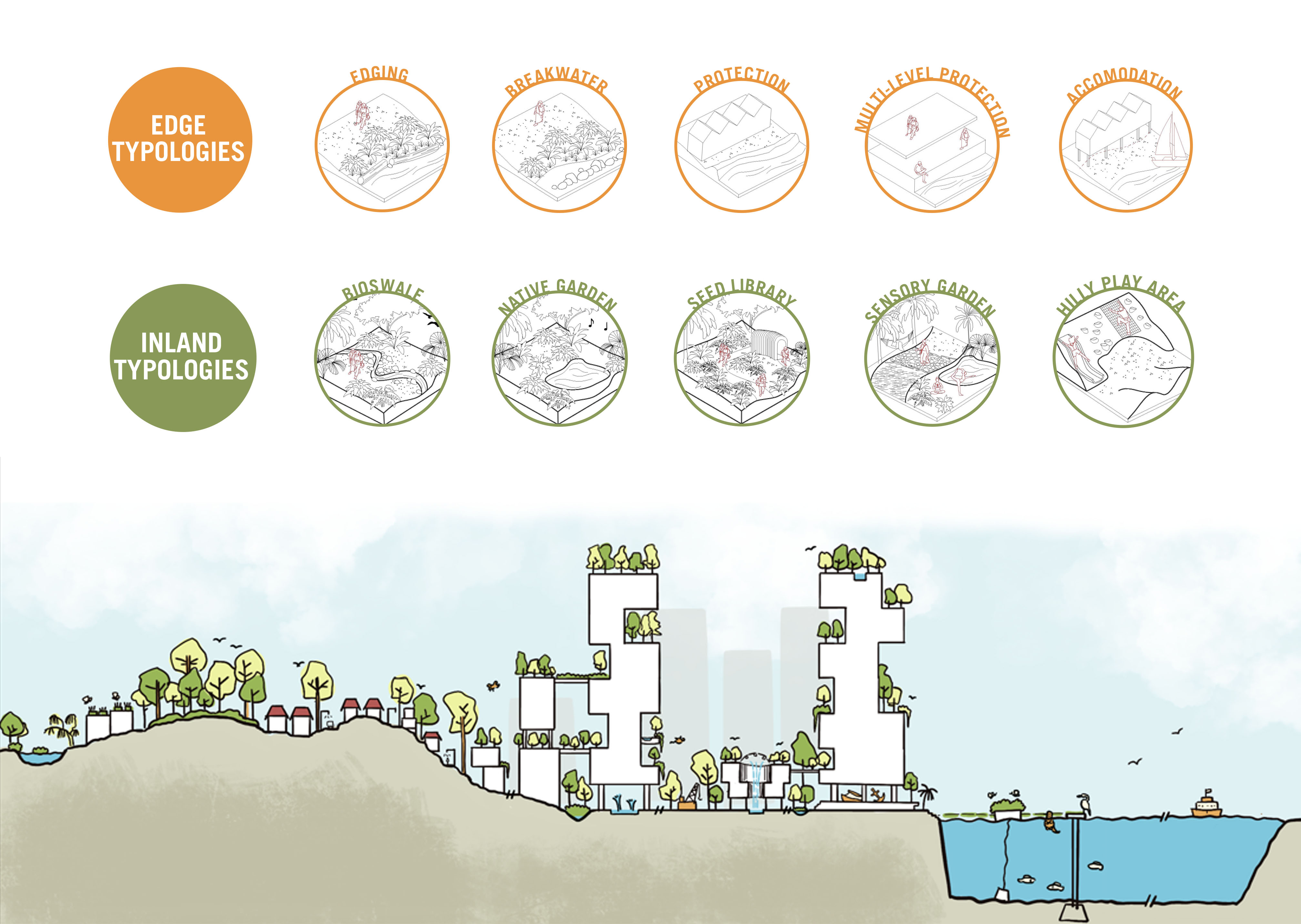
Growing focus on designing urban ecosystems can pave the way for life regenerating methodologies. In response to an increasing urbanised footprint, we advocate for a deeper understanding of different system relationships. The redirection of attention can assist us, as practitioners and a member of the ecosystem, to keenly identify wider ecological needs and innovate with foresight for the resiliency of future cities.
References: UN , TIME , Biophilic Cities , Dezeen , Science Direct , CLC Knowledge Hub , GDRC , Socio Health , NLB , NParks


